Sunday, January 11, 2026

Sangeeta’s dry roasted masala Sunday mutton recipe

Sangeeta’s dry roasted masala Sunday mutton recipe


1 kg mutton

- marinate mutton with ginger garlic paste + 0.5 t turmeric, 1/2 t salt, and 2 T lime juice or vinegar 

Dry roast: 

1 t coriander seeds 

1 t cumin seeds

2 green cardamom 

1 black cardamom

4-5 cloves

4-6 black peppercorns

2 dry red chilies 

6T dry coconut (eqv. to half coconut - that may be too high an estimate.)

+

0.5 t poppy seeds towards the end of roasting so it doesn’t burn.


Roast separately: 

1” ginger, garlic (Indian 5-6 cloves U.S. maybe 1/4 garlic), 1/2 onion cut up.


Grind all above roasted spices and make a paste with some water.

  • In a pressure cooker, fry 1/2 onion & 1 tomato cut up + 1 bay leaf,  then add marinated mutton and stir till water generated during cooking dries
  • Add ground roasted paste toward the end of frying and mix well and stir in water for pressure cooker till throughly mixed  and then cook under pressure (5 whistles/2 min on high + 10 min on low (low enough to not whistle).
  • Garnish with cilantro leaves


Monday, May 27, 2013

A Thousand and One Names

Even without doing the four day Inca Trail trek, which I would have loved to do, going to Machu Picchu was an adventure for us in finding the right person who would take us to our next travel segment or arrangement. Our first entry point was Cusco; we flew in there from Lima. Acclimatized for the rest of the day in Cusco, had wholesome quinoa and chicken soups at Pachapapa in Plaza San Blas (where the steep climb to our abode began) and wandered through the old city to Plaza de Armas -- a beautifully laid out and lit plaza major (the main square).

We added the Sacred Valley tour to the previously made Machu Picchu travel arrangements and so left early to catch the tour bus. Our first handover was from the person at our hospedaje (hostel/hotel) to someone who after first five minutes vanished. Yes, really vanished, never to be seen again. Many tour buses kept coming and filling, but no one called our names. With our limited Spanish and the general chaos of the place we couldn't really get our questions answered. After a good half hour of waiting a bus returned looking for us. They had apparently called our names before with hardly a recognizable syllable. This was the trend for the rest of the trip with flavors of our names we didn't know existed. This delay and a couple of tourist trap shopping stops further delayed the first stop to the ruins at Pisac; the ruins and the hilltop citadel at Pisac were certainly worth the wait though.

Later, I think the only reason we were able to have our paid lunch at Urubamba was because I recognized that the person being repeatedly called out as Imate Dasu (with that spelling) was actually Srimati. I couldn't decide which of the five unclaimed names were mine and so finally I pointed to one of them and then everybody was happy! Eventually, the cumulative delays limited our visit to the spectacular Ollantaytambo ruins to the view from the base of the valley as we had a train to catch (medium gauge and partial windows at the top to see the mountain peaks) for Aguas Calientes, the base of Machu Picchu.

At Aguas Calientes, we were to look for Orlando with a board with our names on it. No board with our names in any form. Well, Orlando decided to bring the board with the hotel name instead (you can guess why). One of the hotel names sounded familiar but we had gone through so many hotel names that we couldn't say that was ours, and yes we were following the instructions. Eventually, Srimati decided to a check with the person with the familiar sounding hotel name and there was Orlando. At the hotel, the guide met us. We declined the sunrise option (surprise, surprise) and chose the eleven o'clock one. One guide with a small green flag was to meet us at the Machu Picchu gate. We reached there after a twenty five minute bus ride with stunningly beautiful scenery and hair raising cliffs. (I think these steep peaks have formed by erosion and exfoliation of a large granitic batholith; granites exfoliate but this is really on a massive scale.)

You can guess by now that there several green flags but none with the guide from the tour sub-contractor. In that chaos, we found this guide as he was calling out yet another set of names that we somehow thought we should check out (developing artificial intelligence?). Not a spot of green on him; he joked that maybe he should wave my green sweater over his head for people to find him. We were then handed over to another guide with a blue umbrella and things went more or less smoothly (except at one point I somehow lost our group while taking pictures and checking out something, and had to go around that circuit twice). See the iconic photo of that spellbinding site.

 On the return journey, the handover I was most unsure of was coming up at Ollantaytambo train station that night. We were to go find a woman named Marina who would have a list with our names - but not a placard this time - and she was to put us on the right bus to Cusco. We were not quite sure how we were going to find her.  But guess again, among tens of placards with people's names, there was a woman with a placard with my name on it the least distorted of all of the ones we had embraced so far. It is another story that Marina couldn't get any of the bus drivers to take our group because all the buses leaving for Cusco were full and clearly proper arrangements were not made for us, but in the end she found a camioneta (a van).

I do want to come back again to do the Inca trail trek. Or do I really want to come back for experiencing a completely new set of handovers?


Monday, April 29, 2013

Earth & Environmental Sciences Awards Luncheon of 2013


The Daily Planetoid LexWire Edition
Saturday, April 27, 2013 From our chief correspondent
Yesterday, in the annual awards ceremony of the  department of Earth & Environmental Sci. at University of Kentucky, a caricature of Tiku Ravat was unveiled.  Comments on his facebook page say that the likeness is spot on. The famed cartoonist Dr. Steven Greb of Kentucky Geological Survey portrayed Tiku Ravat following the departmental tradition of mocking past chairs.  His and the other’s hand in this event was greatly appreciated by Ravat and his friends. 

In the same ceremony, the famed novelist, the National Book Award winner (The Color Purple), the Pulitzer Prize winner and a noted feminist Alice Walker was awarded one of three Outstanding Teaching Assistant Awards.  Ms. Walker sent in her stead, Ms. Walker, to receive the award. She said she greatly appreciated the honor.

The award ceremony also….


Retraction
Monday, April 29, 2013 Editor-in-chief
In the last Saturday’s edition of the Daily Planetoid’s LexNews section, we misreported the Outstanding Teaching Assistant award to the famed novelist of The Color Purple Ms. Alice Walker. It has been brought to our attention that the error was made by Prof. Ravat, who during a last minute rush made the switch, and Ms. Alice Walker does not really deserve this award.  We are told that the real winner of the Outstanding Teaching Assistant award is Ms. Laurel Walker.  Prof. Ravat has since issued a statement acknowledging the error and he also apologized to George White who may have been blamed for his mistake. We are presently interviewing (waterboarding) Prof. Ravat to extract additional information related to this incident. Dr. Greb of Kentucky Geological Survey said he is thinking about how to add the absent-mind of Prof. Ravat to the caricature.

Tuesday, May 22, 2012

What Raj Bhavan Rests On


An article written by me for the Maharashtra Governer's Mansion Complex's Newsletter 'Aaple Raj Bhavan' (Your Raj Bhavan)


There is also a piece written on the article in Marathi by one of the editors of Maharashtra Times, Suhas Phadke.  See the link: http://maharashtratimes.indiatimes.com/articleshow/13323645.cms. In this article he adds a paragraph at the beginning and at the end to give context and the rest is well-paraphrased from my article.


Raj Bhavan, like much of Maharashtra and parts of neighbouring states, rests on a few kilometers thick basaltic lava flows erupted directly from the Earth’s mantle at about 65 million years ago (see Figure 1). These black colored basaltic rocks, which form the Western Ghats and the Deccan Plateaux, cover an area of about 500,000 sq km in much of Maharashtra and parts of Gujarat and are known as the Deccan Traps.  There are only a dozen or so such flood basalt provinces known in the world. 

A view of eroded basalt ledges off Raj Bhavan guesthouse. Can you find these rocks?
Based on the Plate Tectonics concept in geology, the Indian peninsula was in the southern hemisphere at the location of the present Réunion island east of Madagascar at that time of the eruption of these basalts and was moving northward after Gondwanaland (the geologic term for the southern conglomeration of continents named after the Gond tribe in India) fragmented in the Jurassic period around 150 million years ago. About 65 million years ago, the peninsula encountered a newly formed hot upward jet of molten mantle material known as the Réunion Hotspot, which is still erupting in its original location in the southwestern Indian Ocean in the form of volcanoes on the island of Réunion.   The stationary hot upward jet of the mantle melted the rigid outer layer of the Indian lithospheric plate and injected basaltic magma through its very ancient crust.  While the Indian plate kept plowing northward, some two to three billion cubic kilometres of this basaltic lava - extremely hot with the temperature of 1200°C and viscous liquid like jaggery or honey at room temperature -- crept over the region.  All previous vegetation and fauna lay completely charred and buried under these lava flows. 

Geologists and geophysicists have technologies to see through these thick basaltic rocks; they have conjectured pre-hotspot failed continental rifts (places where continents begin to separate but don’t quite make it into ocean basins) and could contain hard to reach petroleum and/or natural gas resources.  The Bombay High is one of the more accessible associated petroleum deposits formed on the western continental margin of India.

Sunday, April 12, 2009

Of strings, kettledrums, imanusts, teachers, and learners


It was as if the gods had descended from the heavens (which gods, which heavens?) to mesmerize us with their music - and they took my pain away. Oh, what a week at the university which brings us a 32 million dollar basketball coach and an e-mail from the university president about no raises for the second year in a row. And this after nine weeks of too many things at work and lack of sleep – all of which I survived only because of generosity of all my friends. I have a lot jumbled in here after a long absence in the blog world - well, I have indeed spent my full semester’s worth of life and work in these nine weeks. [If this were on the Colbert Report tonight’s word segment, the panel on the right on would say “And what a pathetic life!”.]

The same week that brought us the above disasters also brought us Amitav Ghosh (my favorite favorite author), an excellent teacher’s workshop, and the santoor and tabla of Pandit Shiv Kumar Sharma and Zakir Hussain - not to mention my racquet grip and tennis footwork finally sync’ed-in using tips from the USTA web pages.

I tried to learn tabla from an uninspiring teacher in my school days (I then thought all teachers were supposed to be able to teach equally well), and you know how that ended. This week, a teaching workshop made me reflect on the magic of inspiring teachers. When I was not motivated, I was so screwed up that even a fun math teacher couldn’t get me to classes. [The panel on the right says, “other attractions of Bombay didn’t need that much traveling.”]

The math professor, however, was a lot of fun, and to this day I regret not going to his classes. In one of the few classes I happened to attend the professor explained the scientific phrase “for all practical purposes” like this: You have a boy and a girl on two sides of a classroom facing each other and, on each count, they would walk half the distance toward each other. There comes a time when the distance that theoretically remains between them doesn’t matter and they are there for all practical purposes! [Well, he said a step at a time, but saying half the distance makes the example more meaningful for teaching exponential functions and I can use the example to explain radioactive (age) dating – no pun intended.]

When I was finally motivated, even 300 student classes didn’t bother me (and I have had them from superstar and novice professors alike without different learning outcomes – and that’s because I was doing the work). The advice I always give to my students and friends’ kids is: if you sit in the first row, it is always like having a class to yourself – you really can’t tell there are 300 people behind you. [The right panel on Colbert’s Tonight’s Word: “He is deaf and blind.”]

It was exciting to tell Amitav how the Ibis has traveled through one of the biggest depressions in the shape of the Earth - the Indian geoid low of some 70 meters height. Ships are below the average Earth in that location. A mass deficiency (probably a developing hotspot) inside the Earth keeps this giant imanust (my made up word for the reverse of tsunami) entranced. Another curious fact of geophysics is that ships go up and down through this geoid depression in the ocean surface without expending any energy. He seemed fascinated by these tidbits. (Will the sequel to Sea of Poppies begin there?)

The brain can perform amazing things under hypnosis, and that’s what the two maestros did with their performance. Beat by beat, they restored clarity and perspective. (The “panel on the right” says, “… and his sleep hours.”).

And now on to all the piled up homework to make, homework and papers to grade, lectures to prepare, papers to review/edit, papers and proposal to write. Hopefully, tennis will be sufficient to help keep me on an even keel!

Thursday, July 20, 2006

Deadly Recycling


Observations of earthquake scientist Rus Wheeler (USGS) on the damage from the 26 May 2006 earthquake in southcentral Java in Indonesia:

Thanks, Tiku, for the additional damage photos. This was a moderate earthquake (M 6.3), but it occurred on land instead of offshore and probably at shallow depths. Thus, it was close to the most severely damaged areas, although the damaged area was relatively small based on the Shakemap and Did-You-Feel-It maps on the Web pages for this earthquake at http://earthquake.usgs.gov/. And yesterday, farther southwest, a much bigger earthquake occurred (M 7.7), which released about 100 times as much energy. However, this one was well offshore in the Indonesian trench, so most of the damage and deaths were from a 2-m-high tsunami.

Your photo shows the distraught woman in the rubble of her home. The photo also shows a small cleared area in which someone was beginning to salvage and organize individual stone or concrete blocks. Worldwide, such unreinforced masonry is the single deadliest building material because it is brittle and cannot flex to withstand shaking. It is also heavy and squashes people. Unfortunately, it is widely available where other materials can cost more, if they can be obtained at all. I expect that the survivors of the earthquake will have little choice but to rebuild with the rubble from the last earthquake, to repeat the cycle.
It is only a matter of time until a large earthquake occurs under a megacity somewhere in the world. Roger Bilham, a geophysicist at University of Colorado, Boulder, has been telling us for several years that one day an earthquake will kill a million people. I also recall a talk given by Charley Langer, a former colleague here about two decades ago, after he returned from an aftershock survey following the Spitak earthquake in Armenia. Spitak was a town of 25,000 people. Most of them appear to have lived in multi-story apartment blocks that were constructed according to the Soviet practice of supporting thick concrete floors on pillars with little or no reinforcing, one story after another. The floors pancaked and no one had a chance. As Charley stood up to begin his talk, the room was filled with the usual scattered chatter. He didn't say a word for several minutes, but just began to show one slide after another. The chatter stopped, and it stayed stopped. The slides showed piles on piles of concrete rubble, with nothing standing except the occasional corner of a concrete building. The town was virtually wiped out in an instant.

The memory of those slides helps to keep me focused on my work. Thanks again for the photos. They provide a dimension that is not usually available for our Web site.


Rus


My Postscript:
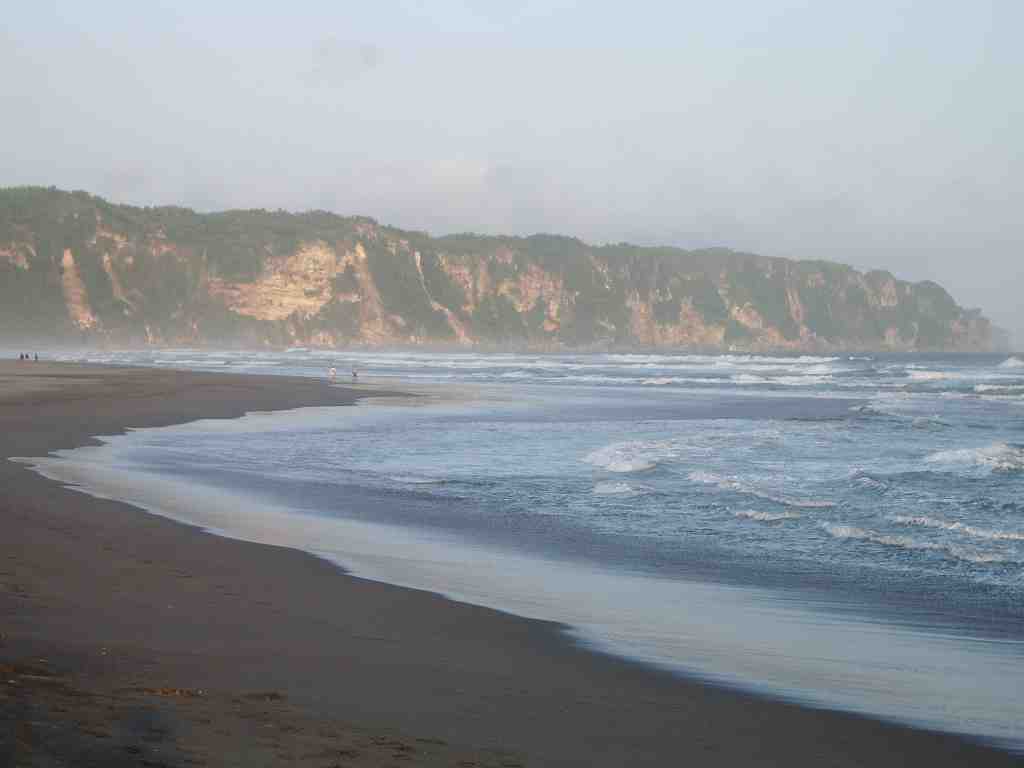
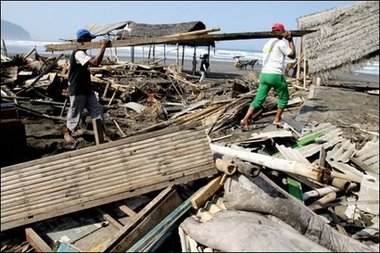
We were walking on the Parangtritis beach (south of Bantul, which was destroyed by the 26 May 2006 earthquake) only 12 days before the July 17 earthquake that occurred offshore western Java and created the latest tsunami. We learnt from newpaper accounts that, eventhough this area was some 200 km away from the main brunt of the tsunami, the huts on the beach were washed off. Our private taxi driver/owner, Tori, told us that there were a lot of rumors in Bantul and Parangtritis area about tsunami coming after the May 26 earthquake; the tsunami didn’t occur then. Had an actual tsunami warning been issued this time, it could have been received by the people as the case of "cry wolf". It turns out that the tsunami warning could not be issued due to the lack of instrumentation and information dissemination mechanisms.


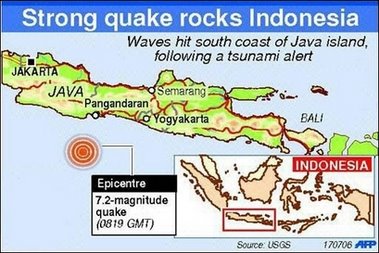
A U. S. Geological Survey graphic of the location of the 17 July 2006 earthquake. Parangtritis beach is south of Yogyakarta.


Huts on Parangtritis beach prior to the tsunami.


Damaged huts from the tsunami on Parangtritis beach from the 17 July 2006 earthquake (Photo credit AFP/Tarko Sudiarno)

Tuesday, July 11, 2006

The Irrestistible Deal


“Your baggage is 8 kg over the limit” said the apologizing tone of the woman at the airline check-in counter. Knowing that our baggage would certainly be over the limit of fifteen kgs, and the 20,000 Rupiah per kg over-the-limit rate we had noticed when we purchased the tickets at Air Asia ticket counter in Denpasar airport, I pulled out two 100,000 Rupiah notes. There was hesitation behind the counter. Had the rate been out of date like nearly every price we encountered in Bali during our visit, I wondered. “That’s 160, right?”

“Do you have a continuing flight?” the hesitant voice continued. “No”, I replied, realising that meant the options for not paying had been exhausted.

There was a secretive low tone conversation between the check-in agent and the baggage handler and the woman said disappointedly, “OK, we will charge you 100.” Ah, I thought, the unrecognisable India has caught up with the familiar one. I said to Srimati, “I guess this means no receipt, huh?” “No, no. Receipt, yes!” the emphatic voice on the other side of the counter intervened.

Srimati and I agreed to the deal we had not counted on making here. I guess we deprived the agent of the enjoyment of making the deal — and she couldn’t stand charging us the “starting” price.

Over our week here, we learnt that there is a “starting” price for nearly everything in Bali. The price is just to get the conversation going — the sale would hardly prove the mettle of either the buyer or the seller without the bargaining exchange.

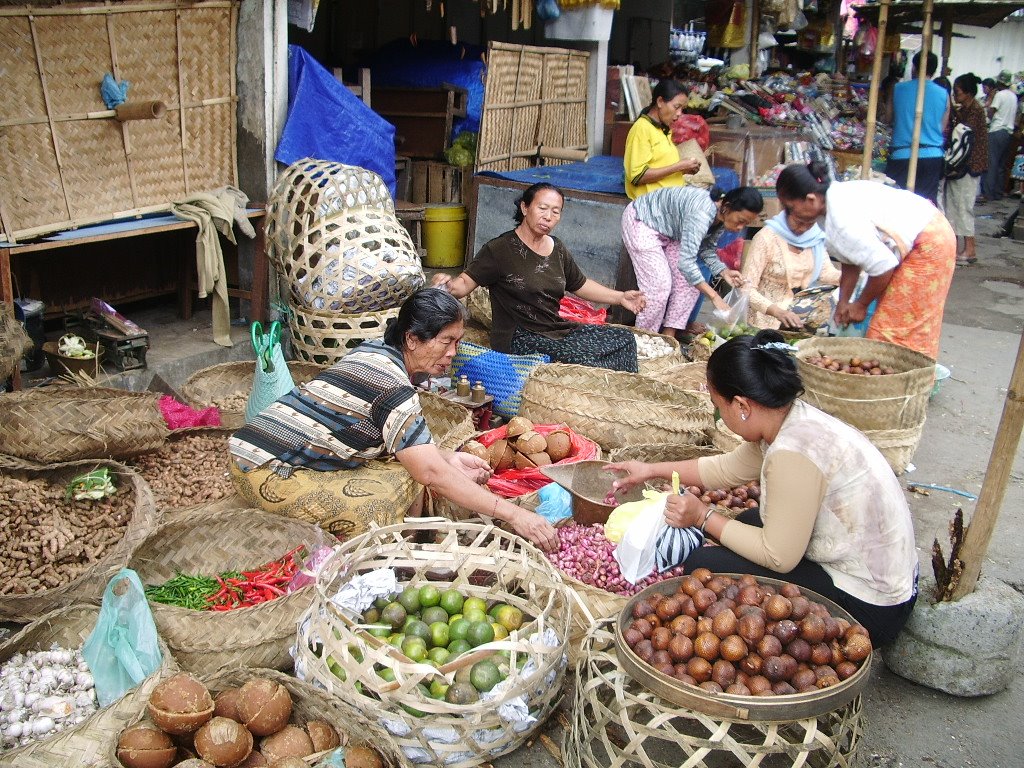
In the Ubud market, after making a very attractive spice deal (I am thinking attractive for us, but it had to be so for the seller also as well for the sale to go through), in which the prices of items agreed and disagreed were too difficult to keep track of because we were negotiating different quantities of 4-5 items at once, and which even produced the “boss lady” in a cameo appearance on the verge of breaking the deal, the level of satisfaction on both sides was so much that I had decided to pay the vendors more upon our return through the maze of stalls. But the same woman, who stuck out her tongue at me in irritation during the negotiations, was extremely friendly and smiling and offered a hand in peace even before I gave the extra money to the boss lady.

Vendors couldn’t always make the deals consistently and to their advantage due to lack of arithmetic skills. On one of our day trips, our tour driver dropped us off at an isolated restaurant for our lunch where prices for the buffet were too high and the entrées on the menu held a worse promise, and while our tour group was debating what to do the waiter made an offer to lower the prices. After a while, our group managed to bring the price of the buffet plus tax to 45,000 Rupiah, in place of the “starting” published price of 60,000 plus 20% tax (the tax is really 10%, and most good restaurants charged us 5% service). The waiter discussed this price with the manager and came back saying that it was too complicated to figure the actual price and tax for our 45,000 Rupiah offer, and that they had decided to make a counter offer of 35 plus 7, totaling 42,000 Rupiah.

Bali is desperate from the decline in tourists after the two bombings. Srimati and I hoped that the Indonesian government would put some resources into diversifying the economy in this place so it won’t have to live by the ebb and flow of tourism. Perhaps we could enjoy the deals more wholeheartedly then.